The Cycle of Fifths
When musicians speak about the cycle of fifths, they may be referring to one of two related, but different, ‘cyclical’ patterns involving the interval of a ‘fifth.’ There is a twelve-note pattern comprising a chromatic sequence of perfect fifths, in which each successive pitch is equidistant from both the preceding and succeeding pitch. So, the sound of a perfect fifth is formed from two pitches separated by seven semitones, regardless of how the interval is named. For example, the interval from ‘c’ to ‘f-sharp’ sounds like a perfect fifth, even if on paper it is spelled as ‘c’ to G-flat. The same quality of sound is obtained if the ‘c’ sounds above (higher) than the F-sharp or G-flat. But an interval will only be called a fifth if the spelling shows a span of five letter names. So the following intervals are all ‘fifths’:
C to G / D to A / E to B / F to C / G to D / A to E / and B to F.
However, if you count the intervening pitches, B to F spans only 6 semitones. So, while it is still called a fifth, it is characterized with the name, “diminished” fifth. You can find a great deal of text and images about all this on the internet.
(also called the circle of fifths, likely because of the most typical visual form used to convey the idea), Note that it is also referred to as the ‘circle’ of fifths, mainly due to the typical circular design with which it is most often displayed. But the circular presentation does convey the most typical pathway of this functional dequence of harmonic it does The diatonic circle of fifths has its own page of explanation and exercises but here is a bit of what’s there. This ‘diatonic’ circle of fifths is a specific arrangement of the seven notes comprising any specific key (that is, scale). If those seven scale tones are arranged as a sequence of descending intervals of a fifth, all seven scale degrees will be included after only seven descending fifths. Beginning from the note ‘C’, for example, the sequence of seven tones would be <c, f, b, e, a, d, g, c>. To see the fifths more clearly I’ll insert the five scale degrees in between these seven descending diatonic fifths.
|| C-b-a-g-F-e-d-c-B-a-g-f-E-d-c-b-A-g-f-e-D-c-b-a-G-f-e-d-|| C
Take a moment to notice that the same seven tones will result from a sequence of seven ascending diatonic fourths:
|| C-d-e-F-g-a-B-c-d-E-f-g-A-b-c-D-e-f-G-a-b-|| C
The expression “circle (or cycle) of fifths” can be confusing, because the same phrase is used when naming both the chromatic as well as the diatonic cycle of fifths. The diatonic cycle (sometimes referred to as the “tonal” version), provides the basis for understanding the most commonly used sequences of bass lines and chord progressions. The diatonic cycle of fifths normally uses only (or mostly) the pitches in the given key, and it is the most common basis for harmonic movement within a given key area. So there appears only the occasional accidental (sharp or flat), since all the notes arise from within the same key.
are most often referencing the tonal version of the cycle, as opposed to the chromatic version.
The diatonic cycle of fifths forms as you pass through, by successive intervals of descending fifths, the seven tones of a normal seven-tone scale (also referred to as a ‘heptatonic’ scale). And, since each of these notes can generate a triad above itself, there are seven triads formed using the seven pitches. It can be a bit confusing, but the cycle of fifths can refer both to the seven notes as well as the seven triads formed ‘above’ each of those notes. So the diatonic cycle of fifths is comprised of the seven triads formed from each of the seven degrees of the same scale, that is, each of the seven triads is also formed from the notes of that same scale. These triads are connected to form harmonic cadences and progressions, and these connections are typically effected by means of sequential movement through successive scale degrees, or by tones common to successive triads. They can also be connected “functionally” (for example, by means of their dominant triad), and these triads, are often musically linked by what’s called a diatonic sequence. You can find more complete and detailed material on the internet and you can find some exercises with those materials at this link: Diatonic Cycle of Fifths
This exercise concerns the sequence of perfect fifths (or fourths) which, because of its inherent chromaticism, cannot be considered to be in a specific key. While it is not an“atonal” exercise, there is no sensation of tonal centre, since the exercise moves quickly from one stability to the next. However, familiarity with the cycle is considered de rigueur for understanding chord relationships, root motion, and harmonic progressions.
I often gave this collection of exercises to piano improvisation students for several reasons. It is a way to become cognizant of the location of these most important intervals—perfect fifths and perfect fourths. [For insight into the layout of the keyboard and the ability to quickly locate intervals without analysis, see https://caseysokol.squarespace.com/blog/keyboard-topography. Facile knowledge of those intervals are needed for intelligent chord formation, for playing bass lines, even for forming resonant tone clusters in free improvisation. The exercises also invite pianists into more demanding challenges of musical attention, which is useful for all your other musical work. For some pianists, there will also be some new challenges for piano technique and some new ideas for ensemble collaboration as well as for your compositional invention.
The Cycle of Fifths (PDF file) (This is a PDF of the Sibelius file and will open in a new window.)
Audio file of the Cycle of Fifths PDF file (This is a MIDI rendition of the Sibelius file.)
Live Performance:
Etude for Two Pianos (Cycle of Fifths) (performance with Prof. Glenn Buhr; from duo-piano concert at Wilfrid Laurier University)
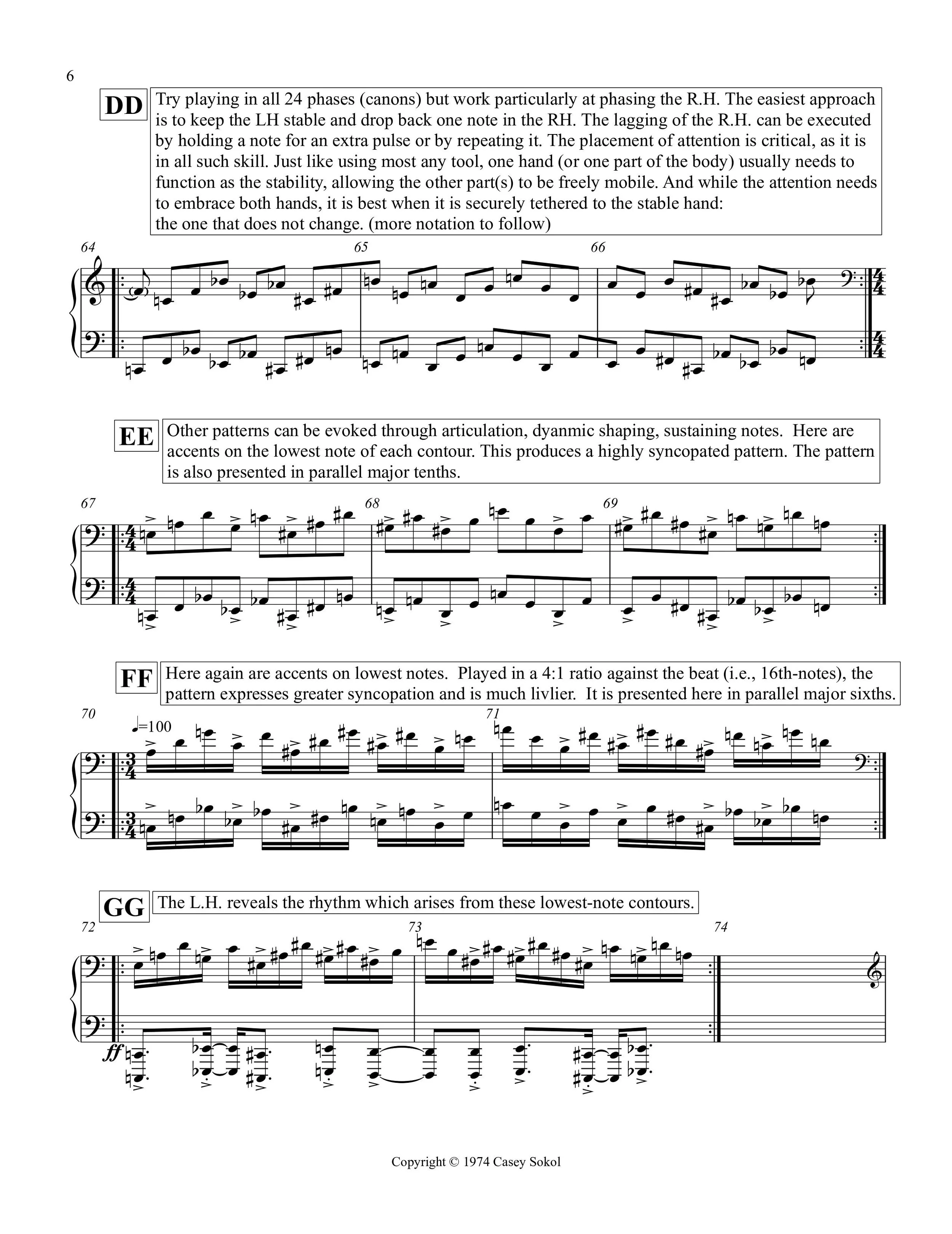
This is not an audio file of all the exercises on this post. It’s limited to the 24 ‘phases’ of the 24-note cycle of fifths (that is the 12-note cycle of fifths followed by its retrograde). It’s not at all intended as a performance piece but Glenn thought it would be an interesting addition to our duo-piano improvisation concert. The ‘premier’ performance of my *Etude for Two Pianos was at the opening of the 1994 Winnipeg New Music Concert Festival. It was played by conductor Bramwell Tovey and Glenn Buhr (composer in residence with the Winnipeg Symphony at the time). This recording was made in a 2001 concert at Wilfrid Laurier.
* A request for the score came in a long-distance call from a pianist who attended that concert and was excited to include the etude in her concert repertoire. I had to explain that there was no score; the whole piece was simply a 24-note loop, performed with continuous rhythmic displacement. Unfortunately the two pianos are not recorded with equal presence, so the effect of the pattern displacement is somewhat diminished.




=================================================================
=================================================================
I thought it might be useful to those who are visiting this post to see how such materials might play out in a more developed creative project. The link here is to a twenty-minute dance piece commissioned for three-pianos based on a 1953 award-winning fantasy novel by Theordore Sturgeon, “More Than Human.” The plot, in brief, is described on Wikipedia. “The novel concerns the coming together of six extraordinary people with strange powers who are able to "blesh" (a portmanteau of "blend" and "mesh") their unusual capabilities. In this way, they are able to function as one organism. They progress toward a mature gestalt consciousness, called the homo gestalt, proposed in the novel as the next step in the human evolution.
The cycle of fifths was one of several interval sequences I employed as the compositional basis for the piece which is linked below (both the score and recordings). You can see how this and the other interval sequences were used in helping to narrate the story, identifying the characters and events, something like a leitmotif.
The commission for this piece came with an interesting requirement which presented difficulties for composing. The choreography and musical composition were not to begin until we were in the same city and working together. In order to produce preliminary musical suggestions and responses to the choreography and the story, some amount of writing had to be completed with sufficient lead time for the pianists to learn it and record the music for the dancers to work with. There was very little time to put this all together and I realized that I needed an approach to the composing that would be very modular—not only modular in form but also in materials. I saw that, rather than try to begin with any notions of a fixed piece at the beginning, it would be best to compose materials that could be reassembled in different ways, perhaps something like changing patches on an early Moog synthesizer. This interval exercise which was formulated years before turned out to be the fulcrum around which the whole process would be connected.
Each character has a slightly different interval sequence by stacking major and minor thirds in various combinations. It was subtle but worked very well, like associating lighting cues with elements of a story. The playfulness of the teleporting twins was best energized by simple alternations of M3s+m3s. Other characters (or events) were represented by sequences such as M3+M3+m3 or m3+m3+M3, and Janie—who is the Conscience of the new multi-organism—is the only character represented by fourths, specifically the Cycle of Fourths (Fifths). Only in mm.240-280 does the rigour of the interval principle give way to a poignant lyric section.
Here is a PDF of the score… Species
and a recording of the premiere (no video) Species live performance
And a MIDI performance … Species (MIDI)